Top 10 Places To See In Bhutan
Page updated: 16 July 2026
Introduction:
Bhutan nestled in the Himalayas is a very special place that is a true privilege to visit.
When planning your trip, there are many ‘must-see’ places to make your visit as rewarding as possible and to assist you we have listed below our Top Ten Places you should visit in Bhutan.
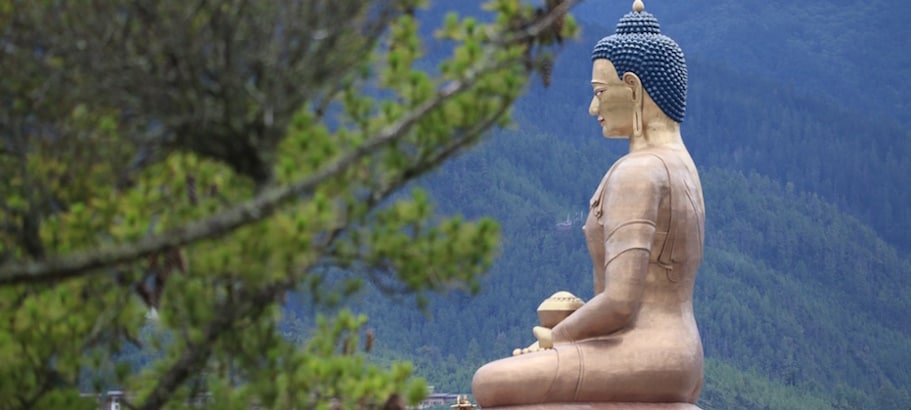
Buddha Dordenma – Thimphu
Aka ‘the Golden Buddha statue’. We love this visually spectacular work of art and the statue can even be seen from space! At 54 meters tall it took 9 years to construct. In 2025 the site was upgraded and the Buddha now houses a Lhakhang (temple) containing 125,000 miniature Buddhas. An awesome and very revered site, which also now boasts a new cafeteria nearby.
With wonderful views over the Thimphu city & valley it is both spiritually & scenically an essential site to visit, being purposely built to bring ‘peace & prosperity’ to planet earth! Additionally there is a terrific 3 km hike (1 hour) through the adjacent Kuensel Phodrang National Park that circumambulates the statue and its lhakang (temple).
HINT – Visit early as the crowds build up by mid-morning.
Royal Textiles Academy – Thimphu
Sounds pretty boring, but this little gem is a must-see. Bhutanese weavings & textiles are considered some of the best quality in the world. Brilliantly displayed in the high walled museum are traditional garments; many styles still worn today. You’ll only need to be there 45-60 mins to be rewarded with essential knowledge of Bhutan’s artistic past & present that will greatly help your understanding of how Bhutan ticks.
HINT – There is a retail shop on site and the popular Craft Bazaar outside, on the main street through Thimphu, so factor in some extra time for a wander. The Bhutanese are not into ‘hard-sell’ so you can mingle comfortably without hassle. (Closed Sun, Mon & Public Holidays)
ENQUIRE NOW
BOOK NOW!
OR CALL THE BHUTAN TRAVEL EXPERTS ON
James – 0412 416 111, Nicola – 0413 598 669
A combination of a fortress, a monastery and an administrative centre, for the surrounding region, Dzongs are a ubiquitous feature in almost every valley in Bhutan.
Originally constructed to repel constant Tibetan invasions they are still functioning extremely well in the modern age. Punakha Dzong is Bhutan’s finest dzong, dating back from the 12th century, and the second oldest in the Kingdom.
Wandering through the dzong’s labyrinth-like alleys and temples one comes across monks chanting and learns a little of the Buddhist ‘Circle of Life’ from learned & passionate guides. A delightfully true story is the 4th King spied his 4 future wives (all sisters) from the top of the entrance stairway and the rest is history.
HINT – very steep stairs up to the Dzong entrance but worth the effort! Also take time to cross Bhutan’s longest pedestrian suspension bridge, over the nearby Mo Chhu (river).
Punakha Dzong – Punakha Valley

Chimi Lhakhang – Punakha Valley
A short walk across rice paddies, from the little village of Sopsokha, brings you to Chimi Lhakhang; arguably Bhutan’s temple with the most ‘colourful’ history. Legend has it a notoriously eccentric, albeit very clever monk, named Drukpa Kunley, built the temple as a ‘fertility symbol’ and it is adorned with phalluses inside and out.
Those women wishing to conceive still visit the lhakhang for a ‘wang’ – which involves being struck on the head by a large 10 inch phallus by the resident monk! Not surprisingly Drukpa Kunley was also known as the ‘Mad Monk’ or the only slightly more polite ‘Divine Madman’! Don’t miss it.
HINT – do take the 20 min walk each way if you can however there is now a road to the lhakang for those with limited fitness.

Phobjikha Valley
This whole valley area is just so special many don’t want to leave. At 2900 metres altitude this relatively remote spot offers a tantalising mix of scenic beauty; a very revered monastery called Gangtey Goemba; some extremely traditional villages; some of the best hiking in the Kingdom and the visitation of the rare Black-Necked Cranes from Tibet between OCT and MAR.
And for those wanting a special treat the Gangtey Lodge or Six Senses Luxury Lodge are the perfect places to lap up the unique atmosphere in this most delightful location, or enjoy a glamping experience at the 4-star rated Gangtey Tent Resort, featuring permanent tents with underfloor heating and attached bathrooms.
HINT – Consider a farm-house stay with a local family in this valley between APR and OCT. It’s a little too cold in the winter months.
The Royal Heritage Museum, Trongsa vs Ogyencholing Museum in Tang Valley
Trongsa is the birthplace of Bhutan’s royal family – the Wangchuck dynasty. This excellent museum has been built into the ancient watch tower overlooking the Trongsa Dzong. Wonderful views of the Dzong & forested valley complement an engaging audio-visual introduction. Then time to wander up the spiralling stairs and floors of the museum displaying a wealth of historical artefacts. Also a great place for lunch and a comfort stop!! Not to be missed for those going as far as Bumthang in central Bhutan.
HINT – The museum is closed on Govt holidays, Saturday & Sundays, so make sure you are passing through or stopping over on other days.
ALTERNATIVELY, if you are venturing as far as the more remote TANG Valley in central Bumthang, consider visiting the Ogyen Choling Museum at the Ogyen Choling Guesthouse. Quite possibly Bhutan’s best museum for those fortunate enough to factor in time in this valley.
HINT: Ideally stay a night at the Ogyen Cholingguesthouse and consider the Bushman Trail hike of 6-8 kms, taking approx 3-4 hrs and rated ‘Moderate’; meaning a reasonably good fitness level is required.
Chumey Handicraft Centre – Chumey Valley, Bumthang.

This area is the heart of weaving and handicrafts in Bhutan. Here you can chat with the lady weavers and relish in the handicrafts shop which has ‘something for everybody’ from weavings & fabrics to jewellery, masks, carpets, paintings, Thangka’s and more.
It is a most engaging spot and the proprietor makes a very tasty, albeit fiercely strong, arra (local spirit) which he happily plies complimentary to all who will take it.
HINT: Allow an hour at least here. On occasions we have struggled to get our travellers out of the shop within the 40 mins allotted time.
Kurjey Lhakhang – Choekhor Valley, Bumthang.
With a gathering of three temples, to the 108 stupas surrounding them, and then the imprint in rock of the Guru Rinpoche in a temple shrine, the Kurjey Lhakhang has it all from a historic and spiritual perspective.
The central Bumthang region is as far east as most Bhutan visitors venture and it consists of the four valleys of Chumey, Choekhor, Tang & Ura. Choekhor valley is the home to this revered lhakhang and this is where three of Bhutan’s former Kings remains are housed. You are in the heart of Buddhism in this region of the Kingdom.
HINT – for the more active hike back from Kurjey (approx 4 km) to your hotel for lunch.
Taktsang Goemba & Hike – Paro Valley
It is only fitting that Taktsang, aka Tigers Nest Monastery, is Bhutan’s most iconic image & monastery. It’s rich legend & history, and the fact it burned down in the late 1990’s and was completely rebuilt within 7 years, all make the pilgrimage hike to Taktsang a most rewarding endeavour. Its location 800 metres above Paro valley, and enveloped into a sheer rock face, is nothing short of astonishing. Best not to attempt this, at times, strenuous hike, at the beginning of your Bhutan stay as you’ll be better prepared after acclimatization and it makes for the perfect end to your Bhutan experience.
You’ll need 2-3 hours to hike to the monastery viewpoint & back which is a convenient turnaround point for the less fit and also comes with a traditional Bhutanese vegetarian café. A delightful spot to gaze at the monastery in comfort.
For those undertaking the full round trip hike into the monastery itself please allow up to 5 hours including time in the monastery. All Bhutanese desire to make this pilgrimage at least once in their lives with each step earning merit points towards their next incarnation.
HINT – Start the hike very early to avoid the crowds, plus the monastery only accepts visitors entering up to 3pm – and the last section of the hike into the monastery has many, many steps and can be quite hard going unless you are at least moderately fit.

Kila Nunnery – Chele La Paro Valley
If you are looking for an ancient way of life go no further than the Kila Nunnery, Bhutan’s oldest nunnery. Situated at around 4000 m in a forest at Chele La – a pass between Paro & Haa valleys, the nunnery previously housed 50+ nuns at any one time, although now only has a few in residency and most transfer lower down to Paro valley over the colder winter period from late NOV-early March.
Visitors are welcomed, although please be aware you are going right back in time on this excursion; the nuns lead an extremely simple, basic lifestyle and rarely speak. Choose to hike to the nunnery through the forest or drive close by for a short ascent to the nunnery carved in to the base of a rock face.
Your options are to return to Paro or continue down into the remote Haa valley for the afternoon or stay a night. The more adventurous can return from the pass to Paro on mountain bikes.
HINT – you are high up! So the less fit will be better driving to the nunnery.
